Hand Exercises That May Help Protect Your Brain
Recently I posted a video about finger and hand exercises for brain health, and it sparked a lot of interest. Many people asked how something as simple as moving your fingers could possibly help your brain.
It turns out there’s actually scientific research supporting this idea.
A 2023 systematic review and meta-analysis of randomized controlled trials looked at whether finger exercises could improve cognitive function in older adults and people with mild cognitive impairment (MCI), Alzheimer’s disease, or dementia. The researchers analyzed 11 clinical trials including over 1,200 participants, and overall they found that finger exercises were associated with improvements in cognitive testing and daily functioning, especially in people with mild cognitive impairment.
Why Finger Movements Are Good for the Brain
Your hands occupy a huge amount of real estate in the brain.
If you look at the motor cortex — the area that controls movement — the parts responsible for the hands and fingers are disproportionately large. This means fine finger movements activate a large network of brain regions.
Research suggests several possible mechanisms.
1. Finger movements stimulate brain networks
Complex finger movements require coordination between multiple brain areas, including:
Motor cortex
Sensory cortex
Cerebellum
Frontal executive networks
Because of this, practicing coordinated finger movements may help strengthen connections between these regions and improve cognitive processing.
2. They may promote neuroplasticity
Motor learning — including finger training — has been shown to trigger structural changes in the brain, improving how efficiently neurons communicate with each other.
This process is called neuroplasticity, which is the brain’s ability to adapt and reorganize itself.
The more we engage in coordinated movements, the more the brain strengthens those neural pathways.
3. They may increase brain-supporting proteins
Some research suggests that motor activity may increase levels of brain-derived neurotrophic factor (BDNF).
BDNF helps:
Support neuron survival
Improve synaptic plasticity
Strengthen learning and memory pathways
This is one reason physical activity in general is associated with better cognitive health.
What the Research Actually Found
Across the studies analyzed, finger exercise programs were associated with improvements in several cognitive measures:
Montreal Cognitive Assessment (MoCA)
Average improvement: about 1.5 points
Mini-Mental State Exam (MMSE)
Average improvement: about 1.4 points
Activities of Daily Living (ADL)
Participants also showed better independence in daily functioning.
Interestingly, the benefits were strongest in people with mild cognitive impairment, and less pronounced in people with more advanced dementia.
That suggests these exercises may be most helpful early in the cognitive decline process.
How Often Were These Exercises Done?
In most studies, participants practiced finger exercises:
10–60 minutes per session
1–3 times per day
For 1–6 months or longer
Researchers also found that more total exercise hours were associated with better cognitive outcomes.
So consistency matters.
Examples of Finger Exercises Used in Studies
Some of the movements used in these studies include:
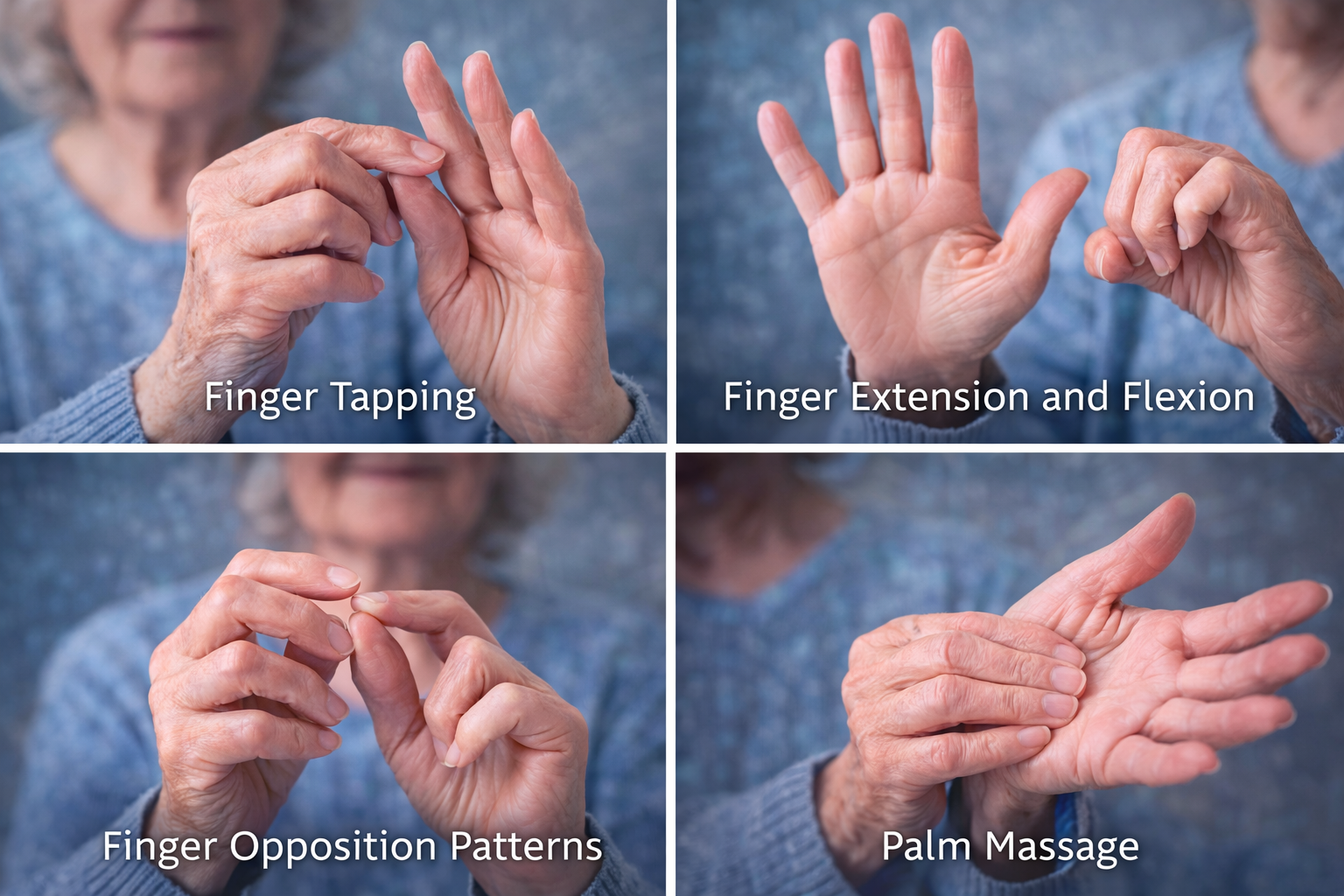
1. Finger tapping
Tap each finger to your thumb sequentially.
Thumb → Index → Middle → Ring → Pinky
Then reverse the order.
2. Finger extension and flexion
Open and close your hand repeatedly, focusing on fully extending the fingers.
3. Finger opposition patterns
Touch the thumb to each fingertip while increasing speed.
This challenges coordination and sequencing.
4. Palm massage
Massaging the palm and fingers stimulates sensory pathways in the brain.
5. Finger counting patterns
Perform coordinated finger movements while mentally counting patterns (for example 1-2-3-4 sequences).
This adds a cognitive task on top of motor movement, which may amplify brain activation.
Why I Like These Exercises
As a neurologist, I like interventions that are:
Simple
Safe
Accessible
Evidence-based
Finger exercises check all those boxes.
They’re not a cure for dementia, but they’re a low-risk way to stimulate brain activity, especially when combined with other brainhealthy habits like:
Regular exercise
Good sleep
Mediterranean-style diet
Social engagement
Lifelong learning
The Bottom Line
Finger exercises are a simple, low-cost strategy that may help support cognitive health, particularly in people with mild cognitive impairment or early cognitive decline.
They activate brain regions involved in movement, coordination, and cognition and may help promote neuroplasticity through repeated practice.
They're not a cure for dementia, but they are a safe and accessible way to challenge your brain alongside other healthy habits such as exercise, sleep, social engagement, and lifelong learning.
Small daily habits can add up.
Sometimes the simplest things, even moving your fingers, can help keep your brain engaged.
If you enjoyed this article, you may also enjoy Train Your Brain, my 27-page guide to neuroplasticity, hand exercises, and cognitive engagement. It includes step-by-step photo demonstrations, a 30-day challenge plan, progress trackers, and the science behind the exercises featured in my videos.
Download Train Your Brain here → $26.99, instant digital download
— Dr. Suraj Malhan
