Eagle Syndrome
The Overlooked Cause of Throat, Neck, and Facial Pain
If you’ve ever had persistent throat pain, ear pain, or facial discomfort that no one can quite explain, there’s a rare condition that sometimes gets missed: Eagle Syndrome.
Most people, including many clinicians don’t think about it often because it’s uncommon. But when it does occur, it can cause a wide range of symptoms that mimic everything from neuralgia to TMJ disorders. Understanding it can help patients finally make sense of symptoms that otherwise feel mysterious.
Let’s break it down.
What Is Eagle Syndrome?
Eagle Syndrome is a condition caused by an elongated styloid process or a calcified stylohyoid ligament.
The styloid process is a small, thin bone that extends from the base of the skull just below the ear. Normally, it measures about 2–2.5 cm in length. In some individuals, this structure becomes elongated or abnormally angled, or the ligament attached to it becomes calcified.
When that happens, it can irritate nearby nerves, blood vessels, or surrounding tissues—leading to pain in the face, throat, ear, or neck.
The condition was first described in 1937 by Dr. Watt Eagle, an otolaryngologist at Duke University.
Interestingly, while about 4% of people may have an elongated styloid process, only a small fraction of them actually develop symptoms. The true symptomatic rate is estimated around 0.16% of the population.
Why Does Eagle Syndrome Happen?
There isn’t just one explanation, and several theories exist.
Some possible causes include:
1. Post-Tonsillectomy Changes
Originally, Eagle believed the condition often developed after tonsil surgery, where scar tissue could form around the styloid process and irritate nearby structures.
However, many patients with Eagle syndrome never had a tonsillectomy, so this can’t be the only explanation.
2. Ossification of the Stylohyoid Ligament
Another theory suggests that embryologic cartilage remnants (called Reichert cartilage) may gradually turn into bone over time.
3. Metabolic or Hormonal Factors
Some studies suggest possible links to:
Hormonal changes, particularly in women
Calcium and phosphorus metabolism abnormalities
Chronic inflammation or trauma
4. Aging and Degenerative Changes
As we age, ligaments lose elasticity. Degenerative changes in the stylohyoid ligament complex may contribute to calcification or elongation.
In reality, Eagle syndrome likely results from multiple factors rather than a single cause.
Symptoms of Eagle Syndrome
One reason this condition is tricky is that symptoms can vary widely.
Most patients develop symptoms in their 30s or 40s, and women appear to experience symptoms more often.
Common symptoms include:
Persistent throat pain
Ear pain (otalgia)
Pain when swallowing
Difficulty swallowing
A foreign body sensation in the throat
Neck pain when turning the head
Facial pain
Headaches
Tinnitus
One classic symptom is pain in the tonsillar area that radiates toward the ear.
Many patients describe a constant dull pain, although some experience sharp neuralgia-like episodes.
Symptoms often worsen with:
Turning the head
Chewing
Swallowing
Yawning
Two Types of Eagle Syndrome
Clinically, we typically think about two forms of Eagle syndrome
Classic Eagle Syndrome
This version is more associated with tonsillar trauma or prior tonsillectomy.
Symptoms include:
Throat pain
Ear pain
Pain when swallowing
Foreign body sensation in the throat
The pain is usually related to irritation of nearby cranial nerves, particularly:
Trigeminal nerve (V)
Facial nerve (VII)
Glossopharyngeal nerve (IX)
Vagus nerve (X)
Vascular Eagle Syndrome (Stylocarotid Syndrome)
In this form, the elongated styloid process compresses the carotid artery or nearby sympathetic nerves.
Symptoms may include:
Pain along the carotid artery distribution
Headache
Vertigo
Syncope
Transient ischemic attacks (TIAs)
Head rotation may worsen symptoms because it increases pressure on the artery.
How Eagle Syndrome Is Diagnosed
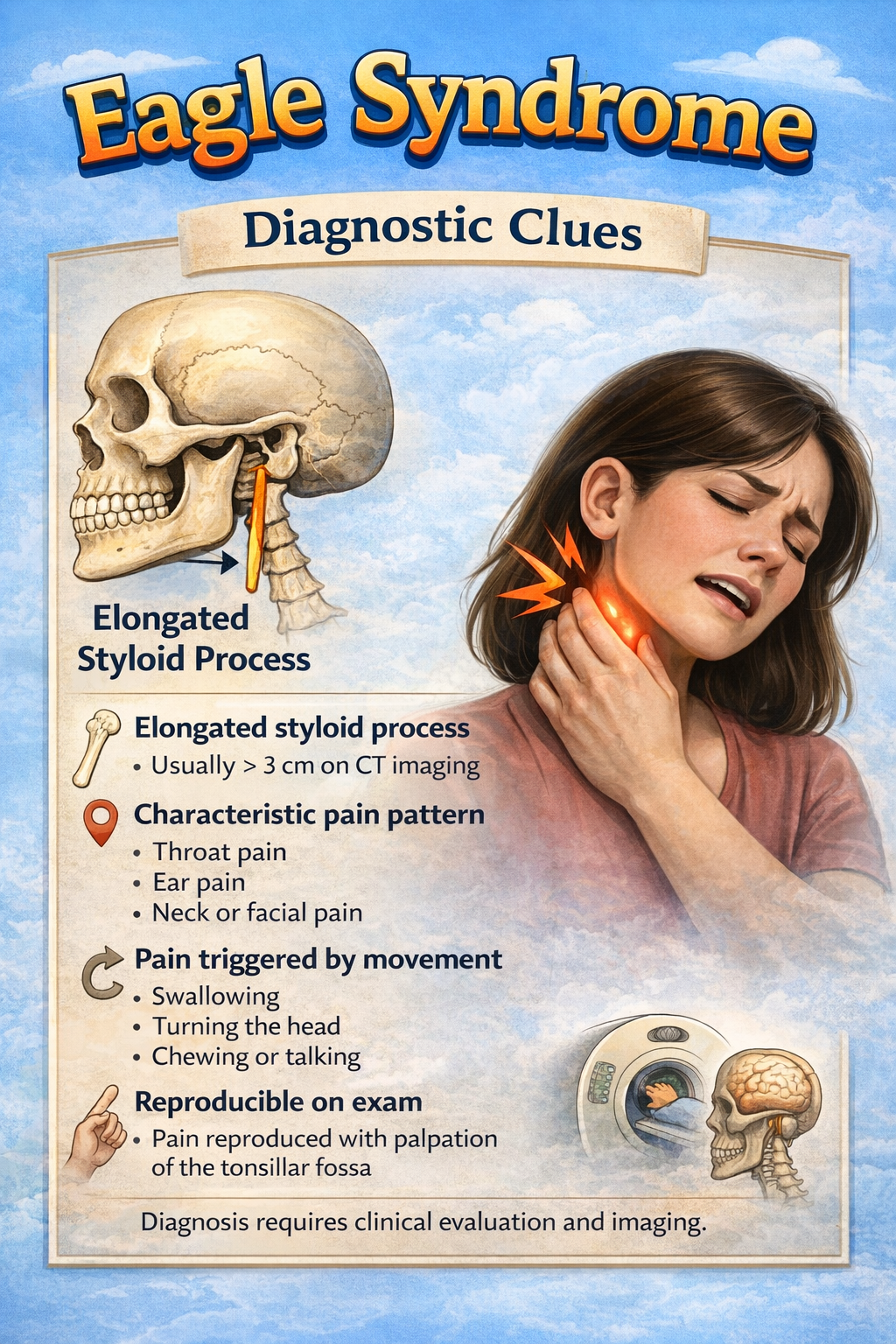
Diagnosis starts with clinical suspicion.
Because the symptoms overlap with many other conditions, Eagle syndrome can be mistaken for:
Temporomandibular joint disorders
Glossopharyngeal neuralgia
Migraine
Trigeminal neuralgia
Cervical spine disorders
Dental issues
Head and neck tumors
A key part of the exam involves palpating the tonsillar fossa. If gentle pressure reproduces the patient’s pain and sends it toward the ear or face, it raises suspicion for Eagle syndrome.
The diagnosis is then confirmed with imaging.
Best Imaging Test
The most accurate study is:
CT scan with 3-D reconstruction
This allows clinicians to measure the styloid process and evaluate any ligament calcification.
In vascular cases, CT angiography may be performed to evaluate carotid artery compression.
Treatment Options
Treatment depends on symptom severity.
Conservative Treatment
Many patients begin with non-surgical approaches, including:
NSAIDs
Neuropathic pain medications
Antidepressants
Anticonvulsants
Local steroid or lidocaine injections
Heat therapy
These strategies aim to reduce inflammation and nerve irritation.
Surgical Treatment
If conservative therapy fails, surgery may be considered.
The most definitive treatment is styloidectomy, which involves shortening the styloid process.
Surgery generally has good outcomes, although studies report failure or persistent symptoms in up to 20% of cases.
Why Eagle Syndrome Is Often Missed
The biggest challenge with Eagle syndrome is that its symptoms overlap with many other conditions.
Patients may see multiple specialists before receiving the correct diagnosis, including:
Dentists
ENT physicians
Neurologists
Pain specialists
Because the condition is rare, it simply isn’t the first thing most clinicians think about.
But for the right patient, especially someone with unexplained throat, ear, and facial pain worsened by head movement, it’s an important diagnosis to keep in mind.
Final Thoughts
Eagle syndrome is uncommon, but when present, it can significantly affect quality of life. The challenge is that its symptoms overlap with many other conditions involving the head, neck, and face.
Because of this, patients may see multiple specialists before the diagnosis is considered. Awareness of the condition, both among clinicians and patients can help ensure that persistent symptoms are evaluated appropriately.
Like many causes of facial and neck pain, identifying the underlying issue often requires careful history, examination, and imaging when appropriate. Eagle syndrome is rare, but in the right clinical context, it’s an important diagnosis to keep on the radar.
