Visual Snow Syndrome: When the “Static” Never Turns Off
Every few months someone sits in my office and says:
“I see static. All the time. Like TV noise over everything.”
And almost every time they follow it with:
“Am I crazy?”
No. You’re not.
Visual Snow Syndrome (VSS) is real. It’s neurologic. And we now have data from over 1,100 patients confirming that it follows a very consistent pattern.
Let’s talk about what that actually means
What Is Visual Snow, Really?
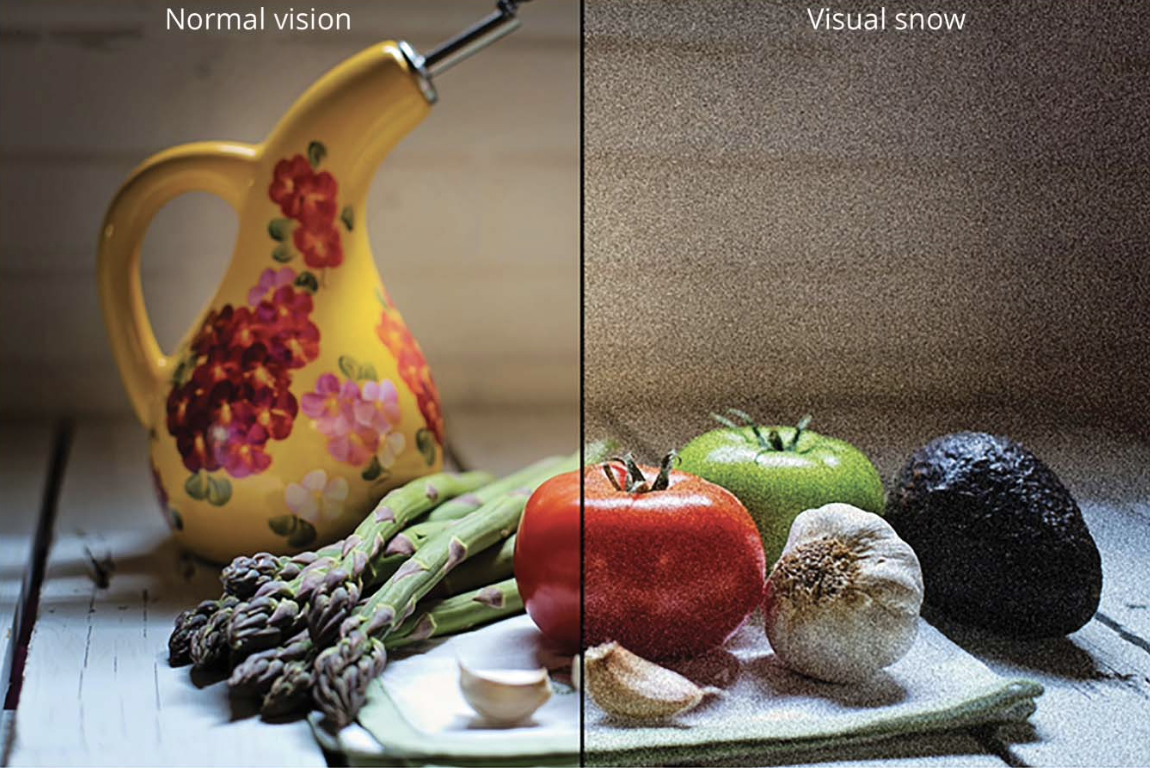
Visual snow is exactly what it sounds like:
Tiny, dynamic dots across your entire visual field.
Not in one eye.
Not just in the dark.
Not just during a headache.
It’s constant.
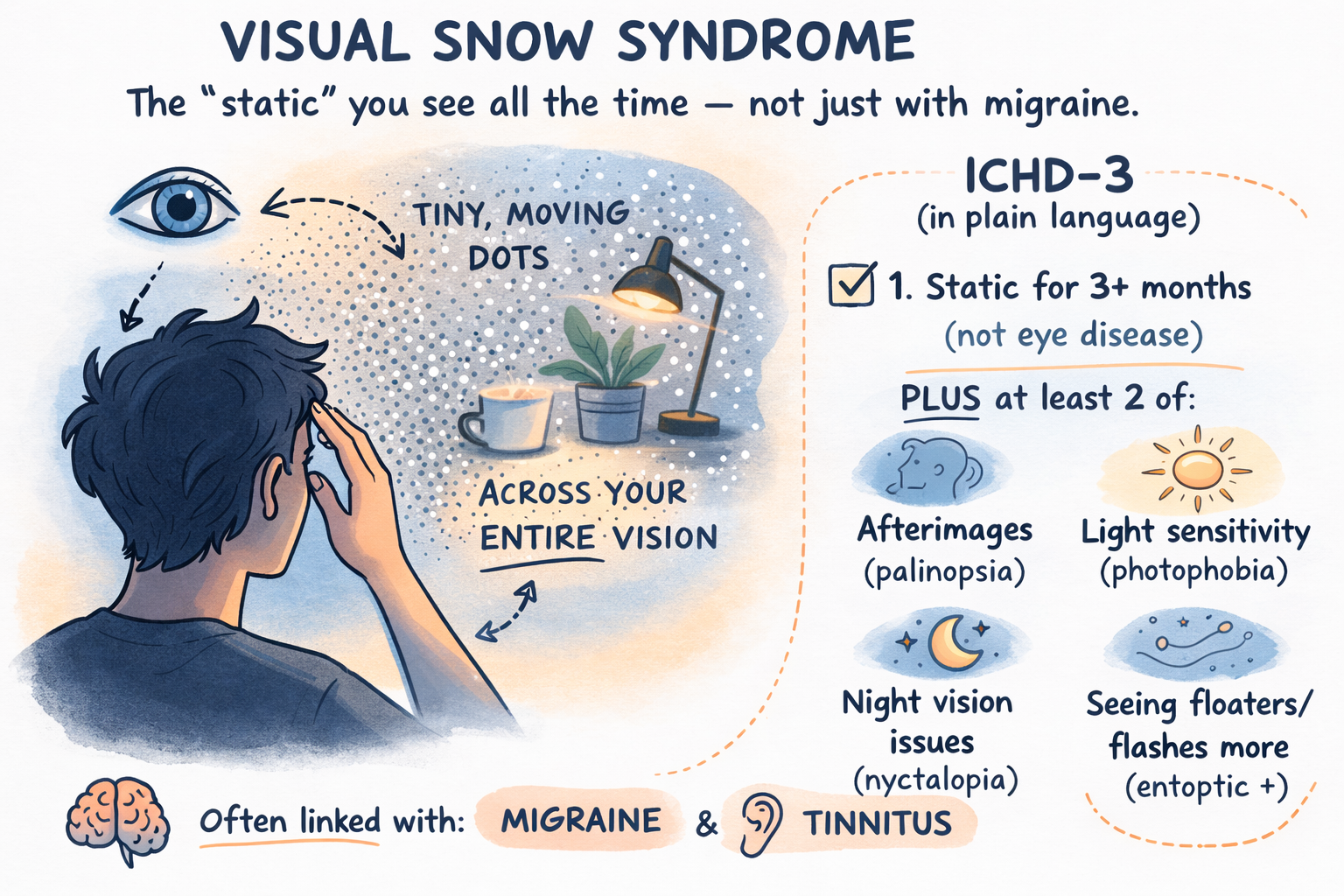
The official criteria (ICHD-3) define it as:
Continuous visual static
Present for more than 3 months
Not explained by migraine aura
Not explained by another eye or neurologic disorder
Most people describe it as:
Black and white dots
Or transparent flickering
Sometimes flashing or colored
It’s usually subtle, but once you notice it you can’t unsee it.
It’s Usually More Than Just Static
Here’s something important.
In the large 2020 Neurology study of 1,061 patients with full visual snow syndrome, most people didn’t just have static.
They also had:
Floaters (86%)
Afterimages (81%)
Light sensitivity (81%)
Difficulty seeing at night (78%)
The average person had about six additional visual symptoms.
That tells us this isn’t just “dots.”
It’s a broader visual processing condition.
When Does It Start?
This part surprises people.
About 40% of patients said they’ve had it for as long as they can remember.
Childhood.
Many didn’t realize their vision was different until they compared notes with a friend or partner.
Others develop it later, sometimes suddenly but for many, it’s lifelong.
That’s very different from migraine aura, which comes and goes.
Visual snow is steady.
Migraine and Tinnitus: The Big Connection
This is where it gets really interesting.
In the study:
72% had migraine
75% had tinnitus
And here’s the key:
People with migraine were 2.6 times more likely to have more severe visual symptoms.
People with tinnitus were about 2 times more likely .
Those effects were independent.
Translation in normal language?
If you have migraine or tinnitus, your visual snow tends to be more intense.
That suggests something shared is happening in how the brain processes sensory input.
Is This Just Migraine Aura?
No.
Migraine aura:
Lasts 5–60 minutes
Spreads
Resolves
Visual snow:
Constant
Present daily
Doesn’t “attack” and then disappear
The criteria specifically separate visual snow from typical migraine aura. They are related conditions, but not the same.
Is This From Drugs?
Another common fear I hear:
“Did this happen because of something I took?”
The researchers were very careful about this. They separated out patients who might have hallucinogen persisting perception disorder (HPPD).
Conclusion?
True visual snow exists independently of drug exposure NEUROLOGY2019003889.
HPPD can look similar. But visual snow syndrome is not simply a drug after-effect.
That distinction matters.
Is There More Than One Type?
The researchers actually ran advanced statistical modeling to see if there were different subtypes.
They didn’t find distinct categories.
Instead, visual snow appears to exist on a spectrum .
Mild end:
Static only
Minimal distress
Severe end:
Multiple visual symptoms
Migraine
Tinnitus
Higher sensory burden
That spectrum concept fits what I see clinically.
What’s Actually Happening in the Brain?
We don’t have a single definitive answer yet.
But research suggests altered processing in the visual association cortex and possible thalamocortical network dysfunction .
In simpler terms: The brain may be amplifying sensory information that most people filter out.
Visual noise that should be background gets turned into foreground. This also helps explain why tinnitus often travels with it, both may reflect altered sensory gating.
What I Tell My Patients
First: you are not imagining this.
Second: this is not dangerous.
Third: it is chronic, but many people adapt remarkably well once they understand it.
The biggest shift I see isn’t from medication.
It’s from:
Understanding what it is
Knowing it’s benign
Reducing hyper-fixation on it
Managing migraine aggressively if present
When migraine improves, visual snow often becomes less intrusive even if it doesn’t disappear.
When Should You Get Checked?
Visual snow should be evaluated especially if:
It’s new and rapidly worsening
There is true vision loss
There’s a curtain-like shadow
There are new neurologic deficits
Because visual snow is a diagnosis of exclusion.
The Bottom Line
Visual Snow Syndrome is:
Real
Neurologic
Often lifelong
Commonly associated with migraine and tinnitus
A spectrum disorder, not multiple subtypes
Not just migraine aura
Not simply drug-induced
And perhaps most importantly: You’re not alone.
If this sounds like you, bring it up. Document your symptoms. Let’s talk through it.
There’s power in naming something correctly.
