 Image 1 of 1
Your Brain Is Not Fixed. It Adapts. Start Here.
Try this right now: touch your thumb to each finger (index, middle, ring, pinky), then reverse. Both hands. 15 seconds.
Did your non-dominant hand fall behind? Did you lose the pattern?
That wasn’t failure. That was your brain meeting something it hasn’t made automatic yet. That’s the challenge of learning a new motor skill, happening right in your fingertips.
You’ve probably seen my hand exercise videos online. My first one was viewed more than 10 million times. People were surprised by how hard something so simple could be. Many started doing them with their parents, spouses, kids, and friends.
The comments kept asking the same things: Slow it down. Teach me each one. Is this actually doing anything?
This guide is my answer.
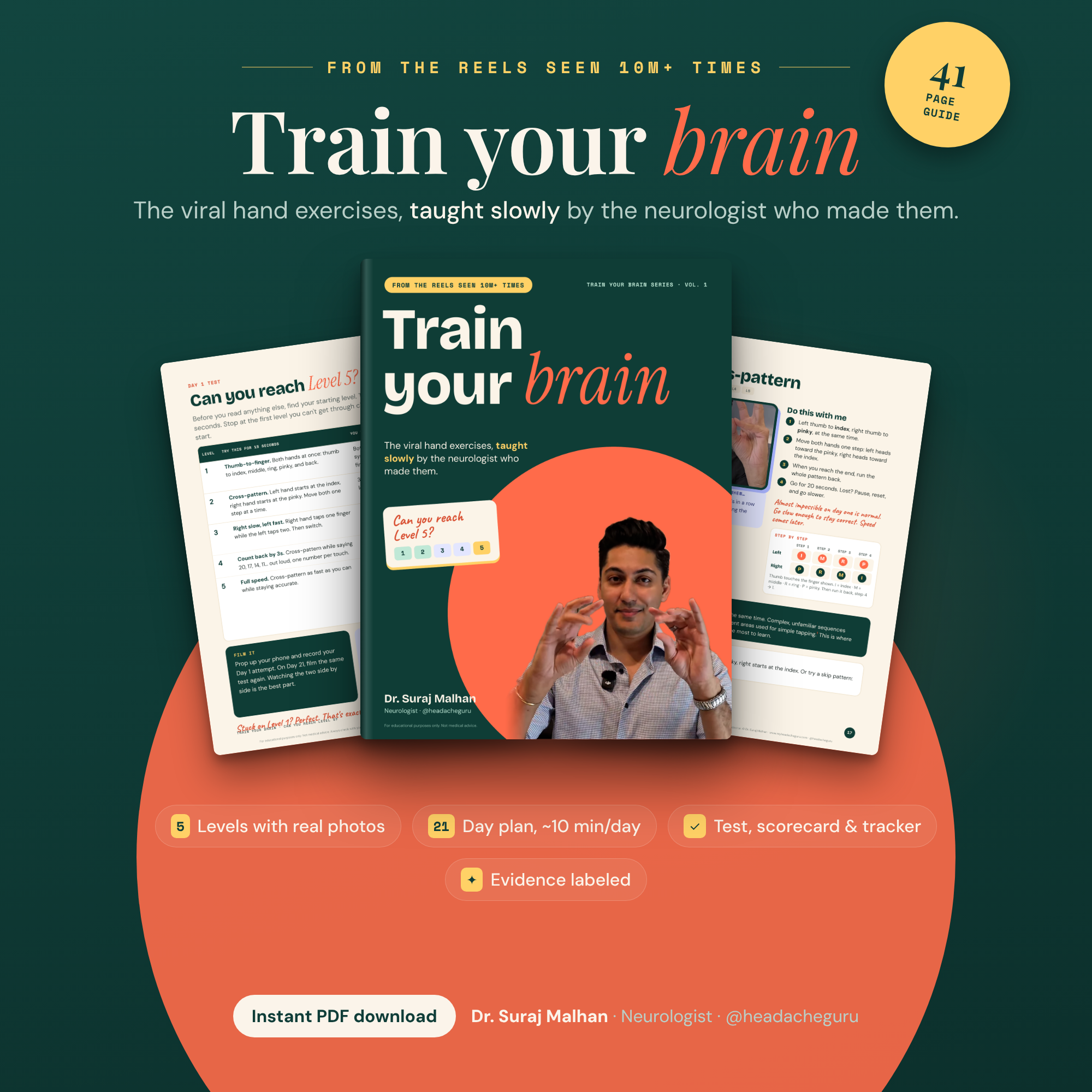
Train Your Brain is a 41-page guide that teaches the same Level 1–5 ladder from the videos, slowly and step by step. It explains why these exercises are harder than they look, and it helps you build them into a simple 21-day habit.
Inside you’ll get:
A 5-level hand exercise ladder with real photo demonstrations and step-by-step instructions
The science of neuroplasticity, explained in plain language
A 21-day progressive plan that takes about 10 minutes a day
A Day 1 test, a scorecard, a 21-day tracker, and a level-up library to keep it challenging
An honest look at what the research does and doesn’t show, with every major claim labeled by strength of evidence
What else research supports for brain health: music, dance, aerobic exercise, sleep, and learning new skills
All 14 modifiable dementia risk factors from the 2024 Lancet Commission, one of the most comprehensive dementia prevention reports ever published
As a neurologist, I’m careful about what I put my name on. No miracle claims. Hand exercises aren’t a dementia prevention program. They’re a fun, low-risk way to challenge your coordination and focus, and a doorway to the habits with the strongest evidence.
I’m Dr. Suraj Malhan, neurologist and assistant professor. I created this guide because the science deserves to be explained simply, and the exercises deserve to be done correctly.
Your brain adapts to what you give it.
Give it a challenge.
Disclaimer: For educational purposes only. Not medical advice. No physician-patient relationship is established. Hand exercises have not been shown to prevent dementia or treat any condition. Digital downloads are non-refundable.