ADHD and Migraine: The Surprising Link
If you have ADHD and migraine, that combination may not be as random as you think.
I’ve been talking more about ADHD lately, and one thing I keep coming back to is how often neurological conditions overlap in ways we don’t fully understand yet.
Migraine is a good example.
For years, studies have suggested that ADHD and migraine show up together more often than expected. More recent research continues to support that connection. The harder question is why.
And this is where social media can make the story sound much cleaner than the science actually is.
You’ll hear explanations like, “It’s all dopamine,” or, “ADHD and migraine are basically the same type of nervous system.”
I wouldn’t go that far. The overlap appears to be real. The biology behind it is much more complicated.
The ADHD-Migraine Connection Is Real
A systematic review and meta-analysis looking at ADHD and primary headache disorders found a significant association between ADHD and migraine.
The odds of migraine were about 32% higher in people with ADHD.
What caught my attention was that the researchers did not find the same association with tension-type headache. That makes this more interesting than simply saying people with ADHD report more headaches in general.
A large Danish study found an even stronger relationship. Researchers looked at more than 26,000 adults and found that people with migraine had about 80% higher odds of ADHD compared with people without migraine.
The association was somewhat stronger in people reporting migraine with visual disturbances, although I would not turn that into a sweeping claim about migraine aura. The difference was relatively modest.
And this pattern has shown up in other populations too.
A nationwide longitudinal study following more than 81,000 people with ADHD found a higher rate of newly diagnosed migraine over time.
The relationship has also been seen in children.
In a population-based study of 5,671 children ages 5 to 12, ADHD was significantly more common in children with migraine, but not in those with tension-type headache. The association also became stronger as headache frequency increased.
So this isn’t one isolated study producing an interesting number. Multiple types of research are pointing in the same direction.
ADHD and migraine really do seem to travel together more often than we would expect.
The Harder Question Is Why
Finding an association is the easy part. Explaining it is much harder.
Correlation does not tell us whether ADHD somehow increases migraine risk, migraine contributes to ADHD symptoms, or both conditions share some of the same underlying biology.
Newer genetic research is starting to make that last possibility particularly interesting.
A 2026 study looked at maternal migraine, genetic susceptibility to migraine, and ADHD traits in children. The researchers used several approaches, including polygenic risk scores and Mendelian randomization, to try to separate shared genetics from a direct causal relationship.
The findings did not strongly support the idea that migraine itself causes ADHD. Instead, the results were more consistent with shared genetic liability contributing to both conditions.
That is a much more interesting story to me.
Rather than one disease causing the other, there may be biological vulnerabilities that increase the likelihood of developing both.
Why I Wouldn’t Blame Everything on Dopamine
Dopamine is usually one of the first explanations people reach for because it plays an important role in ADHD.
But the leap from “dopamine matters in ADHD” to “dopamine explains why ADHD and migraine occur together” is much bigger than it sounds.
Migraine is not simply a dopamine disorder, and ADHD is not simply a dopamine deficiency.
The research points to a broader picture. Genetics appears increasingly important. There may also be overlap in neurotransmitter systems and in how certain brains process sensory information.
Beyond that, things get much murkier.
The brain rarely gives us one neat pathway that explains everything.
Sensory Overload May Be Part of the Story
This is one of the areas I find particularly interesting clinically.
Migraine is much more than head pain.
During an attack, normal sensory input can suddenly feel excessive. Lights seem painfully bright. Sounds become irritating or unbearable. Smells can become overwhelming. Movement can make symptoms worse.
Now think about how many people with ADHD describe their everyday experience.
The television is on. Someone nearby is talking. Their phone buzzes. Someone is tapping a pen. They are trying to work, but their attention keeps getting pulled toward everything happening around them.
Those experiences are not the same thing, and we should not pretend they are.
But the overlap is intriguing.
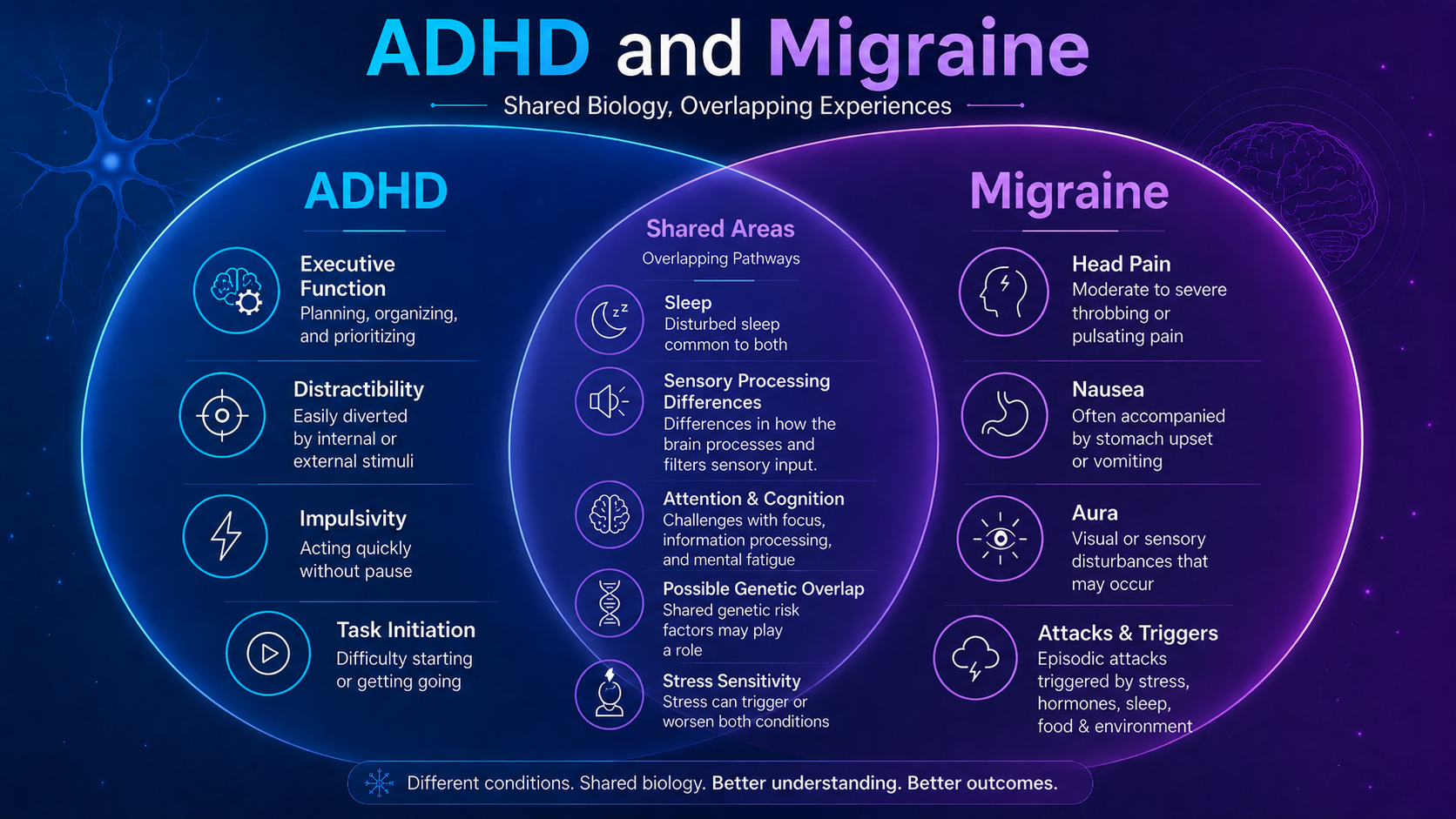
Both conditions can involve problems with how the brain prioritizes or responds to incoming information.
In clinic, these diagnoses also don’t always show up in neat separate boxes.
Sometimes it’s a person with migraine who tells me they have struggled for years with focus, organization, or feeling overwhelmed in busy environments. Other times, someone already being treated for ADHD mentions that missed sleep, bright lights, overstimulation, or a chaotic day seem to line up with their headaches.
That doesn’t prove a shared mechanism, but it does make the research feel a lot less abstract.
Migraine Can Affect Thinking Too
Migraine itself can also affect cognition.
People often think of migraine as a severe headache with nausea or sensitivity to light. But many patients describe brain fog, trouble concentrating, slowed thinking, or difficulty finding words.
Those symptoms can happen during the headache, but they may also begin before the pain starts or linger after it improves.
Now add ADHD on top of that.
Someone who already struggles with attention, working memory, or executive function may feel even more impaired during a migraine attack.
That is not the same thing as migraine causing ADHD. It simply means the functional effects can overlap in ways that matter in everyday life.
Sleep Complicates the Picture
Sleep is another piece I would not ignore.
Poor sleep can worsen attention and executive function. Changes in sleep are also a common migraine trigger for many people.
ADHD itself is frequently associated with sleep problems, including delayed sleep timing and difficulty maintaining consistent routines.
I don’t think sleep explains the entire relationship. It may simply be one more factor that amplifies both conditions in someone who is already vulnerable to them.
This is one reason I tend to think about neurological symptoms as interconnected rather than completely isolated.
The brain doesn’t care which diagnostic box we put something into.
This Is a Pattern, Not a Diagnosis
None of this means that having ADHD predicts that you will develop migraine.
And migraine is certainly not a way to diagnose ADHD.
The research tells us that these conditions occur together more often than expected. That is a population-level pattern, not an individual diagnosis.
What it can do is make us pay closer attention.
If someone with migraine has also had longstanding problems with attention, impulsivity, organization, task initiation, or executive function dating back well beyond their headaches, those symptoms may deserve their own evaluation.
Likewise, recurring migraine symptoms in someone with ADHD should not automatically be dismissed as stress, distraction, or overstimulation.
Where Neurodivergence Fits In
The word neurodivergence naturally comes up in this conversation.
ADHD is commonly included under that umbrella. Migraine is more complicated.
Neurodivergence is not a formal medical diagnosis, and there is no universally accepted medical definition that places migraine within it.
Some people with migraine identify with the term because their nervous system can respond very differently to light, sound, smell, sleep disruption, stress, and other environmental changes.
I understand why that language resonates.
From a scientific standpoint, though, I would be careful about saying “migraine is neurodivergence” as though that were an established neurological classification.
The more useful question is whether studying the overlap between migraine, ADHD, autism, and other neurological conditions can teach us something about shared biology and sensory processing.
I think it probably can.
Where I Think This Research Is Going
My guess is that the ADHD–migraine connection will eventually turn out to involve several overlapping vulnerabilities rather than one neurotransmitter or one brain region.
Genetics is becoming increasingly interesting. Sensory processing probably deserves more attention. Sleep and attention networks may also turn out to be important pieces.
What I find most compelling is the bigger idea behind all of this.
Medicine likes categories.
Migraine goes in one box. ADHD goes in another. Sleep disorders go somewhere else. Anxiety goes somewhere else again.
The brain doesn’t necessarily respect the categories we’ve created for it.
The same genetic pathways can influence more than one condition. The same brain networks can contribute to very different symptoms. Sleep affects nearly everything. And one person can obviously have several neurological vulnerabilities at the same time.
The more we understand those connections, the better we may become at treating the person in front of us rather than treating every diagnosis as though it exists in isolation.
The Bottom Line
The connection between ADHD and migraine has now shown up in meta-analyses, large adult studies, pediatric populations, longitudinal data, and newer genetic research.
What we still don’t know is exactly why.
Shared genetics are becoming an increasingly interesting part of the explanation. Sensory processing and other areas of overlapping neurobiology may matter too. Dopamine may be involved, but reducing the entire relationship to dopamine goes much further than the evidence supports.
Sometimes the most interesting answer in neuroscience is not a neat one.
We know the connection is there.
Now we have to figure out what it means.
References
Salem H, Vivas D, Cao F, Kazimi IF, Teixeira AL, Zeni CP. ADHD is associated with migraine: a systematic review and meta-analysis. European Child & Adolescent Psychiatry. 2018;27(3):267–277. PMID: 28905127. DOI: 10.1007/s00787-017-1045-4.
Hansen TF, Hoeffding LK, Kogelman LJA, et al. Comorbidity of migraine with ADHD in adults. BMC Neurology. 2018;18:147. PMID: 30322380. DOI: 10.1186/s12883-018-1149-6.
Arruda MA, Arruda R, Guidetti V, Bigal ME. ADHD Is Comorbid to Migraine in Childhood: A Population-Based Study. Journal of Attention Disorders. 2020;24(7):990–1001. DOI: 10.1177/1087054717710767. The population-based study included 5,671 children ages 5–12 and found ADHD was associated with migraine but not tension-type headache.
Hsu TW, Chen MH, Chu CS, et al. Attention Deficit Hyperactivity Disorder and Risk of Migraine: A Nationwide Longitudinal Study. Headache. 2022;62:634–641. DOI: 10.1111/head.14306.
Luo Y, Dardani C, Wootton RE, Gkatzionis A, Stergiakouli E. Maternal migraine and offspring ADHD: triangulating the evidence. BMC Medicine. 2026;24:167. PMID: 41689052. DOI: 10.1186/s12916-026-04692-4.
Yum J, Chu MK. Unraveling the connections between migraine and psychiatric comorbidities: A narrative review. Brain & Development. 2025;47(4):104392. PMID: 40633196. DOI: 10.1016/j.braindev.2025.104392.
This article is for educational purposes only and is not intended to provide an individual diagnosis or treatment recommendation.
