Could AI Finally Predict the Right Migraine Medication?
A closer look at a new Mayo Clinic study, what it means for patients, and what it means for anyone building in health tech.
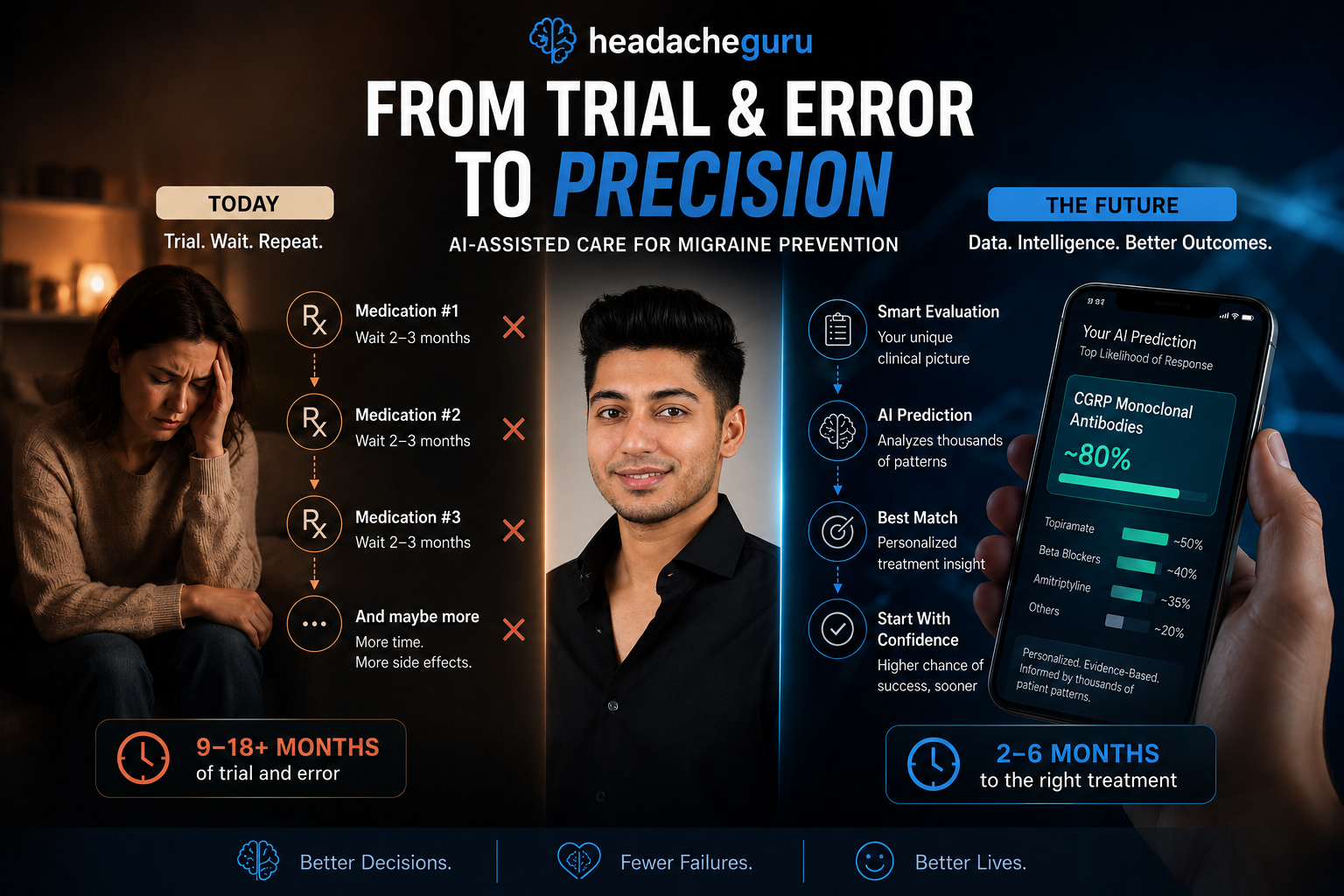
Imagine finally seeing a neurologist after years of migraines.
Together, you decide on a preventive medication.
Then you wait.
Three months later, it didn't work.
So you try another.
Unfortunately, that's still how migraine care often works today.
One of the hardest parts of treating migraine isn't making the diagnosis. It's choosing the right preventive medication.
Even when we make the best evidence based decision, there's still uncertainty. We think about comorbidities, previous medication failures, side effects, insurance requirements, pregnancy plans, and patient preferences.
Even after considering all of that, we still don't know which medication will work best for that individual patient, until we try it and wait.
It's frustrating for patients. It's frustrating for physicians too. And it's one of the reasons a recent study out of Mayo Clinic caught my attention.
Why migraine treatment still involves trial and error
Migraine preventive medications fall into several categories: anti-hypertensives, anti-depressants, anti-epileptics, neuromodulation, onabotulinumtoxinA (Botox), and the newer CGRP monoclonal antibodies. Each class works differently, has a different side effect profile, and, critically, works well for some patients and not at all for others.
Right now, there's no reliable way to predict, before treatment starts, which medication is most likely to help a specific patient. So we make the best evidence informed choice we can, and then we wait. Each unsuccessful trial costs the patient months of continued symptoms, and often comes with side effects that make an already difficult stretch harder.
Why is this such a difficult problem in the first place? Two people can both have migraine and look completely different. One may have aura, another doesn't. One has obesity, another is underweight. One has depression, another insomnia. One responds beautifully to a CGRP antibody while another doesn't respond at all. Migraine looks like one disease on paper. In reality, it's probably many different biological processes that all produce similar symptoms.
That's a big part of why this is such a hard prediction problem, and why AI might actually have something meaningful to offer here.
What the Mayo Clinic researchers did
A team used data from the Mayo Clinic Headache Subspecialty Clinic Database, a resource built from detailed clinical questionnaires collected from patients since 2001. For this study, they analyzed data from more than 4,000 adult patients with migraine, using 145 to 146 clinical and headache-related variables collected before treatment began, including headache frequency, intensity, associated symptoms, and demographic information.
They trained a machine learning model, designed specifically for this kind of structured clinical data, to predict whether a given patient would respond to each of seven commonly used preventive medication classes. Unlike traditional statistical models, machine learning can recognize complex interactions among many clinical variables at the same time, patterns that are often difficult for humans or simpler models to detect. A "responder" was defined as at least a 30 percent reduction in monthly headache days.
What they found
The model showed its strongest performance for CGRP monoclonal antibodies, the newest and most migraine specific class of preventive medication, with reported prediction accuracy around 80 percent. That doesn't mean the model knows which individual CGRP monoclonal antibody is best. It predicts the likelihood of responding to the medication class as a whole. Its performance for older medication classes was more modest, reminding us that this is an encouraging proof of concept rather than a finished clinical tool.
Among the variables that contributed most to the model's predictions were age, headache frequency, body mass index, associated migraine symptoms, and specific attack triggers, findings that align with what headache specialists already understand clinically but haven't previously been able to use in a systematic, predictive way.
This is one study in a growing field, and that context matters
This isn't an isolated result. A 2025 narrative review in the journal Cephalalgia, along with a separate scoping review identifying more than a dozen studies using AI and machine learning to predict migraine treatment response, both point to the same conclusion: this is a genuinely active area of research, not a single company's marketing claim.
At the same time, headache researchers themselves have raised an important caution. A 2024 paper in The Journal of Headache and Pain reviewing the broader body of machine learning research in migraine flagged inconsistent study design and insufficient external validation as recurring problems across the field. That's not a reason for skepticism about the technology itself. It's a reason to be precise about what any individual study, including this one, has and hasn't yet shown.
What this study does not show
It's important to keep this in perspective. This is not a tool that's ready to start choosing medications for patients tomorrow.
The data came from a single headache subspecialty center, meaning the patient population, referral patterns, and even how questionnaires were completed may not generalize to a community clinic or a different country's patient population. The results need to be validated in other patient populations before a model like this could responsibly be used in routine clinical care. That's not a criticism of the research. It's exactly how good science is supposed to work, one careful, honestly reported step at a time.
What this means if you're a patient
If you have migraine, the near-term takeaway isn't that your neurologist will soon hand you an AI-generated prescription. It's that the field is actively working on a problem you've likely experienced directly, the frustration of trying medication after medication with no way to know in advance what might actually help you.
Tools like this, once properly validated, have the potential to shorten that process, even if only for a subset of patients or medication classes at first. Fewer ineffective trials means fewer side effects, fewer follow up visits, and getting back to your life sooner. That's worth being genuinely excited about, while also being clear-eyed about the fact that we're not there yet.
What this means if you're building in health tech
If you're a founder, clinical lead, or executive thinking about AI in this space, a few things from this study and the broader research landscape are worth sitting with.
Generalizability is the real bottleneck, not accuracy. A model that performs well on a single center's data is a promising starting point, not a finished product. The path from "80 percent accuracy in one dataset" to "trusted clinical tool" runs directly through prospective, multi-site external validation. Budget and plan for that stage from the beginning, not as an afterthought.
The clinical variables that matter are often already being collected, just not used systematically. Age, headache frequency, BMI, symptom clusters, and triggers aren't exotic data points. Many headache and primary care practices already gather versions of this information. The opportunity isn't necessarily new data collection, it's better structuring and application of data that already exists in clinical workflows.
Explainability builds trust faster than raw performance does. Clinicians are more likely to adopt and trust a tool that can show which clinical features contributed most to a prediction than one that returns a confident answer with no visibility into why. A clinician doesn't just need to know what the model predicts. They need enough context to decide when to trust it, and when not to. That transparency is also what allows a physician to catch the case that doesn't fit the pattern, which matters enormously in a condition where a small percentage of patients have a secondary or more serious cause hiding behind familiar symptoms.
The economic case is real, even at modest improvement levels. Even a modest improvement in first-line treatment selection could mean fewer ineffective prescriptions, fewer follow up visits, lower healthcare costs, and most importantly, patients feeling better sooner.
I've had many patients ask some version of the same question. How do we know this medication is the right one? The honest answer is that we use the best evidence available, but we still can't predict individual response with high confidence. That's exactly why studies like this matter to me, not as an abstract research trend, but as something that could change what I'm actually able to tell my next patient.
Why this matters beyond migraine
Although this study focused on migraine, I think the implications are much broader. Many areas of medicine still rely on trial and error when selecting treatments. If we can reliably predict which therapy is most likely to work before treatment even begins, migraine may simply be one of the first places where precision medicine becomes part of everyday clinical care.
Where I land on this
I don't think AI is going to replace the clinical judgment that goes into treating migraine. I think it's going to make that judgment better. If we can shorten the months patients spend cycling through ineffective treatments, even for a subset of patients, that's meaningful progress.
That's the version of precision medicine I'm genuinely excited about. The future of migraine care won't be defined by AI alone. It will be defined by how well we use it to help patients get better, faster.
Sources
Chiang CC, Schwedt TJ, Dumkrieger G, et al. Advancing toward precision migraine treatment: Predicting responses to preventive medications with machine learning models based on patient and migraine features. Headache. 2024;64(9):1094-1108. doi:10.1111/head.14806
Keshet Pardo, Schwedt TJ, Cutrer FM, Chiang CC. The promise of artificial intelligence and machine learning for migraine treatment outcome prediction: A narrative review. Cephalalgia. 2025;45(11). doi:10.1177/03331024251395541
Giacon M, Terrazzino S. Predicting Pharmacological Treatment Response in Migraine Using AI/ML: A Scoping Review of the Evidence and Future Directions. Pharmacotherapy. 2025. doi:10.1002/phar.70085
