What Lifting Weights Actually Does to Your Brain
Most people start lifting weights because they want to build muscle, lose fat, or get stronger.
Those are all great reasons!
But as a neurologist, the benefit I find most fascinating has nothing to do with how your body looks. It has everything to do with what's happening inside your brain.
Over the past decade, researchers have discovered that your muscles aren't just responsible for movement, they're also active chemical factories. Every time they contract during exercise, they release signaling molecules that communicate with other organs throughout your body, including your brain.
That discovery is changing how we think about exercise. It may be one of the reasons lifting weights doesn't just make you physically stronger, it may also help support learning, memory, and healthy brain aging.
Your Muscles Are Talking to Your Brain
For years, scientists thought skeletal muscle simply generated movement.
We now know that's only part of the story.
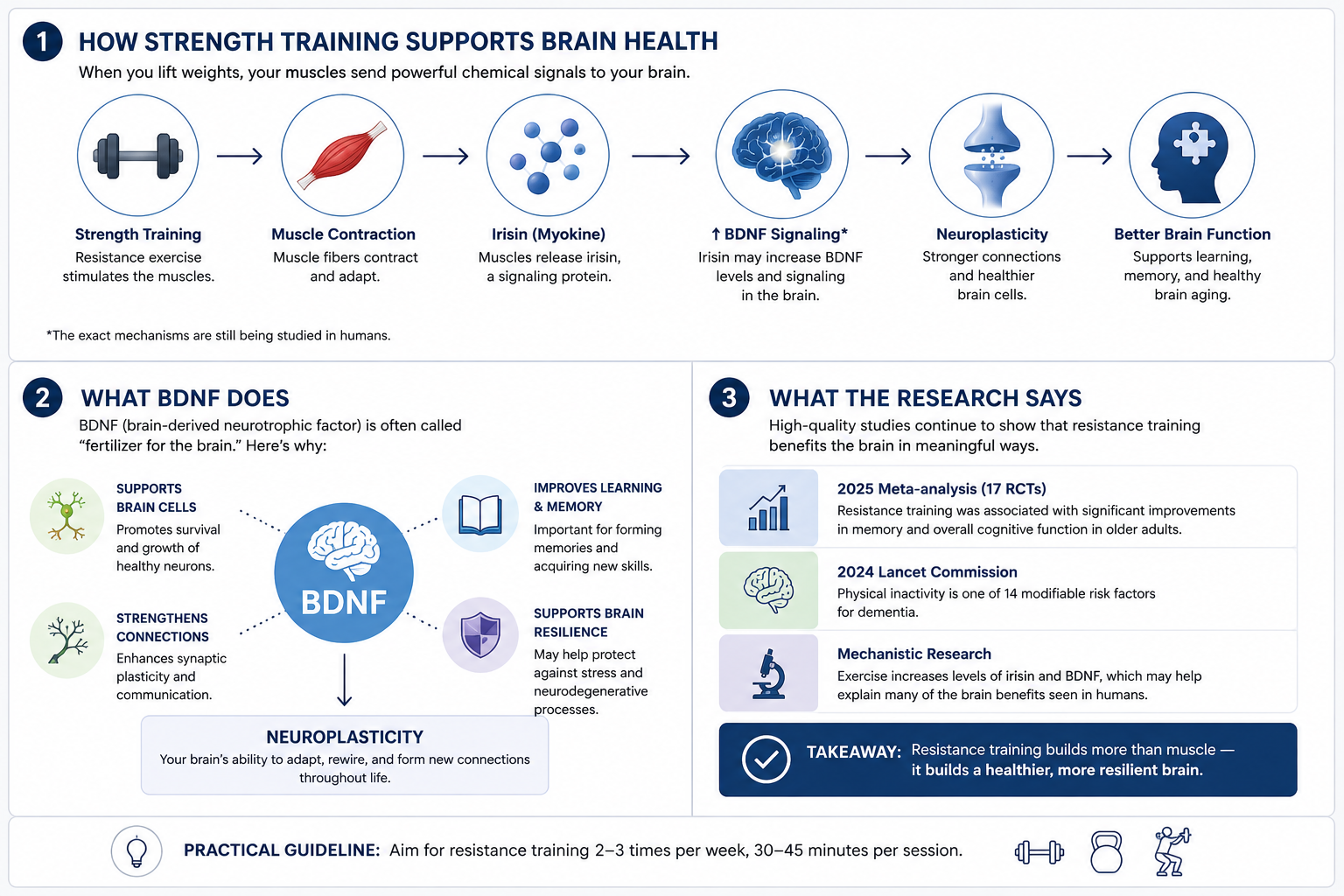
When muscles contract during exercise, they release proteins and signaling molecules called myokines. Think of these as chemical messengers that allow your muscles to communicate with the rest of your body.
One of the most studied is irisin.
Researchers believe irisin may help increase brain-derived neurotrophic factor (BDNF), a protein that plays an important role in learning, memory, and the brain's ability to adapt throughout life.
The easiest way to think about BDNF is this:
Think of it as fertilizer for your brain.
Just as fertilizer helps plants grow, BDNF helps support healthy brain cells and the connections between them. Researchers believe this is one reason regular exercise is associated with better brain health.
Scientists are still working to understand exactly how irisin influences the human brain, but the evidence linking exercise, BDNF, and cognitive health continues to grow.
What Is Neuroplasticity?
One reason BDNF gets so much attention is because of its role in neuroplasticity.
Neuroplasticity is your brain's ability to change throughout your life. It's how you learn a new language, improve at a musical instrument, recover after an injury, or form new memories.
Your brain isn't "fixed." It's constantly adapting.
Researchers believe BDNF helps support this process by strengthening communication between brain cells and supporting the formation of new neural connections.
While exercise is only one factor that influences neuroplasticity, it appears to be one of the most powerful lifestyle habits we have.
What Does the Research Actually Show?
The biology is interesting, but what most people really want to know is:
Does lifting weights actually improve brain health?
The answer is encouraging.
A 2025 systematic review and meta-analysis published in Frontiers in Psychiatry combined the results of 17 randomized controlled trials involving older adults.
Overall, regular resistance training was associated with improvements in memory and overall cognitive function.
That's important because systematic reviews combine multiple high-quality studies, giving us a more reliable picture than any single study alone. This doesn't prove that lifting weights prevents dementia or guarantees better memory for everyone. But it does add to a growing body of evidence suggesting that resistance training benefits more than just muscles.
Can Lifting Weights Prevent Dementia?
This is one of the most common questions I expect after sharing this research.
The honest answer is: We don't know.
No exercise program has been proven to completely prevent Alzheimer's disease or other forms of dementia. However, regular physical activity is consistently associated with healthier brain aging.
The 2024 Lancet Commission on Dementia Prevention, Intervention, and Care identified physical inactivity as one of only 14 modifiable risk factors for dementia.
The word modifiable is important - it means it's something we can potentially change.
Brain health depends on many factors including sleep, blood pressure, hearing, diabetes, smoking, social connection, education, and genetics. Exercise is one factor, but it's one of the few factors that almost everyone can begin working on today.
Does It Have to Be Weightlifting?
Not at all.
Resistance training includes almost any activity where your muscles work against resistance.
That includes:
Dumbbells
Barbells
Resistance bands
Weight machines
Push-ups
Squats
Lunges
Bodyweight exercises
Many of the studies showing cognitive benefits used resistance training about two to three times per week, often for 30 to 45 minutes per session. You don't need a perfect workout plan. You just need consistency. The best exercise program is the one you'll actually continue doing.
Why I Talk About This With My Patients
One of the questions I hear most often is:
"What's the best thing I can do for my brain?"
People are usually expecting me to recommend a supplement, vitamin, or brain-training app. Instead, I often start by talking about movement. Because exercise doesn't just benefit your heart, muscles, or bones. It benefits nearly every organ in your body, including your brain.
The Bottom Line
The next time you're deciding between another 30 minutes of scrolling and picking up a weight, remember this:
You're not just training your muscles.
You're training your brain.
Every workout triggers biological changes that researchers believe may help support learning, memory, and healthy brain aging.
Want More Evidence-Based Brain Health Tips?
If you enjoyed this article, you'll probably enjoy my newsletter too.
Every week, I break down the latest neuroscience and neurology research into practical, evidence-based advice you can actually use, from brain health and memory to migraines, sleep, nutrition, and healthy aging.
Join my free Brain Health Newsletter
and get science-backed insights delivered straight to your inbox.
References
Wu J, Huang C. Front Psychiatry. 2025;16:1708244. doi:10.3389/fpsyt.2025.1708244.
Romero Garavito A, et al. Front Neurol. 2025;15:1505879. doi:10.3389/fneur.2024.1505879.
Medical Disclaimer
This article is intended for educational purposes only and should not be considered medical advice. Exercise recommendations should be individualized based on your health, fitness level, and medical conditions. Always speak with your healthcare professional before starting a new exercise program, especially if you have underlying medical conditions or concerns.
